/59748.tmb-300v.png?sfvrsn=9885965b_2 "For the future - publication thumbnail")

The great convergence:
One Health tackles complex health challenges
in the Western Pacific Region
Experts in human health, animal health, food systems and ecology have long worked in silos. But the COVID-19 pandemic, alongside outbreaks of avian influenza, dengue, leptospirosis, and mpox – to name but a handful of global public health crises – drove home the urgency of collaborating across sectors.
/teams/regional-emergencies-programme-and-division-of-health-security-and-emergencies-(dse)/country-health-emergency-preparedness-ihr-(cpi)/world-health-day_one-health-summit.tmb-1920v.png?sfvrsn=772e91f7_1 "World Health Day_One Health Summit")
Human health does not exist in a vacuum
We are living in an era of spillover.
Roughly 75% of all emerging infectious diseases in humans now originate in animals, causing over 2.7 million deaths each year.
In 2025, Pacific island countries and areas reported the highest number of dengue cases in a decade - an increase attributed to climate change and shifting weather patterns in the region.
The message is clear: human health is firmly tethered to - and inseparable from - the health of animals, plants and the environment that contains us all.
To state the obvious: addressing interrelated challenges requires multisectoral collaboration.
One Health is an approach that connects disciplines to harness collective action, build synergies and collaboratively tackle complex health challenges.
/campaigns/world-health-day/2026/one-health-spotlight-story-oh-explainer.tmb-1920v.jpg?sfvrsn=5c44165e_1 "World Health Day_One Health Summit")
This convergence is exemplified and implemented by the One Health Quadripartite comprising the Food and Agriculture Organization of the United Nations (FAO), United Nations Environment Programme (UNEP), World Health Organization (WHO), and World Organisation for Animal Health (WOAH).
One region; One Health: priority areas for action
The Quadripartite has launched a One Health Joint Plan of Action which focuses on six priority technical areas, also known as “One Health Action Tracks”. These range from strengthening national health systems and preventing zoonotic pandemics to managing food safety and curbing antimicrobial resistance, or AMR.
In the WHO Western Pacific Region, countries are advancing these action tracks with support from the Quadripartite partners. From poultry markets in Java to rural rice-wine-making villages in Cambodia, country examples from the Region showcase how the One Health vision is being brought to life.
/campaigns/world-health-day/2026/one-health-spotlight-story-ino.tmb-1920v.jpg?sfvrsn=301f4316_1 "World Health Day_One Health Summit")
Indonesia | Reducing risks from priority zoonotic disease
As a global hotspot for emerging diseases, Indonesia has felt the direct impact of climate-driven disasters and shifting biodiversity. Recognizing the stakes, the world’s largest archipelago has employed the One Health approach to tackle three priority zoonotic diseases: avian influenza, leptospirosis and rabies.
- Avian influenza: In traditional poultry markets - identified as critical early-warning sites for zoonotic disease spillovers - WHO-supported surveillance teams were piloted across five priority provinces. The pilot generated early insights that sharpened district preparedness, reinforced multisectoral coordination and enabled targeted risk reduction in high‑exposure markets.
- Leptospirosis: When low-lying coastal areas across Indonesia saw a surge in leptospirosis - a climate-sensitive zoonotic disease, WHO supported capacity-building for health-care workers in early detection and prompt treatment, and the establishment of local multisectoral coordination teams to build community awareness. Enhanced community awareness and strengthened health workforce capacities have lowered leptospirosis-related mortality rates across the country.
- Rabies: Endemic in 26 of 38 Indonesian provinces, rabies presents a formidable challenge that has required multisectoral action. WHO advanced crucial response actions, including implementing a joint workplan with multiple partners for rabies prevention and control; amplifying risk communication; accelerating animal vaccination; and advancing surveillance and case management for rabid animals. WHO is now working with the Government of Indonesia to draft a regulation that will accelerate cross-sector collaboration to control rabies.
/campaigns/world-health-day/2026/one-health-spotlight-story-khm.tmb-1920v.jpg?sfvrsn=bcddcc49_1 "World Health Day_One Health Summit")
Cambodia | Advancing food safety systems through multisectoral actions
In Cambodia, methanol poisoning from illicitly produced rice wine has been a recurring tragedy, claiming at least 157 lives since 2014. In 2021, an incident sparked a WHO-led after-action review to identify and address gaps in preparedness and response capacities.
To support the urgent surveillance effort in Cambodia, a rapid-test kit was developed by Singapore’s National Centre for Food Science - a WHO collaborating centre for monitoring and assessing the risk of food contamination in the Western Pacific. The Centre also assessed high-risk areas and consulted diverse stakeholders to detect the presence of methanol in illegal alcoholic beverages.
WHO ensured that capacity-building efforts included both the national and subnational workforce, particularly members of Cambodia’s multisectoral Foodborne Disease Outbreak Investigation and Response Team (FORT). FORT teams continue to receive WHO-led training on preparedness and response measures for food safety incidents.
Furthermore, WHO has trained emergency workforce members from three national hospitals and six provincial and district hospitals in Cambodia in clinical management for treating methanol intoxication. The Organization also provided technical support to implement policy and regulation changes for food safety standards, and supported a public awareness campaign targeted at high-risk provinces and communities.
These efforts have strengthened information-sharing and coordination during food safety incidents. Cambodia has responded to the methanol poisoning crisis by developing a robust, multisectoral response system.
/campaigns/world-health-day/2026/one-health-spotlight-story-mys.tmb-1920v.jpg?sfvrsn=341355fc_1 "World Health Day_One Health Summit")
Malaysia | Partnerships in action to combat AMR
In 2021, bacterial AMR was linked to approximately 17 200 deaths in Malaysia, posing a critical threat to both human and animal health. To address this, WHO and the other One Health Quadripartite members have partnered with Malaysia to implement a multisectoral strategy.
- Strengthening AMR outbreak response in hospitals. Malaysia launched a nationwide, tiered capacity-building initiative to improve AMR outbreak detection and response. WHO leveraged support from the Japan Institute for Health Security - its collaborating centre for AMR surveillance and research - to develop and conduct the outbreak response training, as well as to update national guidelines.
- Advancing integrated One Health AMR surveillance. Under the TRiUMPH initiative - which informs efforts to strengthen integrated AMR surveillance - WHO, along with other Quadripartite members, led a national workshop that enabled multisectoral coordination, standardization and data-sharing.
- Rallying political support for AMR action. Together with the Quadripartite, WHO led multisectoral communication workshops to advocate and garner political support for AMR actions.
/campaigns/world-health-day/2026/one-health-spotlight-story-ton.tmb-1920v.jpg?sfvrsn=3f10b24d_1 "World Health Day_One Health Summit")
Tonga | Addressing the rise of vector-borne diseases
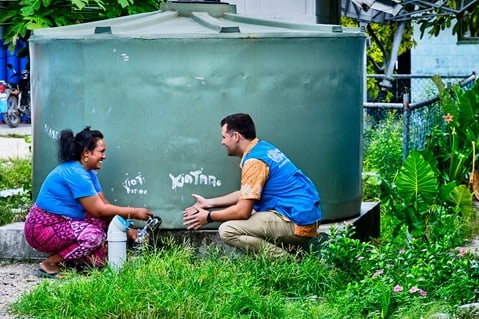
Dengue has increasingly become a serious public health problem across the Pacific, including in Tonga. In 2025, Tonga declared a dengue outbreak that lasted five months, with over 900 reported cases and three deaths.
Tonga launched a response, with support from WHO, that took on a One Health approach, engaging multiple sectors to address dengue and other vector-borne diseases.
Tonga’s Ministry of Health walked the talk in prioritizing stakeholder coordination to first learn about what worked and did not work during previous outbreaks. In addition, the Ministry, with the support of WHO, reviewed its decisions during the response to fine-tune decisions and actions to respond to challenges (also known as an intra-action review).
More recently, Tonga continued to build on their active approach in including voices from across the community. Multiple government authorities, church networks, media, and civil society organizations put strategy into practice through a hands-on training facilitated by WHO.
This hands-on training enabled participants to be more informed on public health safety measures during emergencies, including on effective communications and engagement, and applied principles from newly launched multi-hazard risk communication and community engagement strategy – putting strategy to practice.
Tonga also set a precedent for the Pacific by hosting the region’s first national bridging workshop – a practical step toward preparedness for future emergencies at the human-animal-environment interface.
Participants representing diverse sectors discussed gaps in Tonga’s preparedness and response systems, built connections across sectors, and developed a coherent, resource-efficient roadmap to strengthen Tonga’s capacity – and by extension, the Pacific’s – to detect, prevent and respond to zoonotic and pandemic threats through shared ownership and coordinated action.
/campaigns/world-health-day/2026/one-health-spotlight-story-banner.tmb-1920v.jpg?sfvrsn=23b1adb9_1 "World Health Day_One Health Summit")
These are just a few examples of how countries across the Western Pacific are modelling multisectoral efforts and implementing the One Health approach to advance health for all. The challenges – climate change, habitat loss and disease spillover – are complex. But the solution is simple: we must act as one.